

























Screenshot
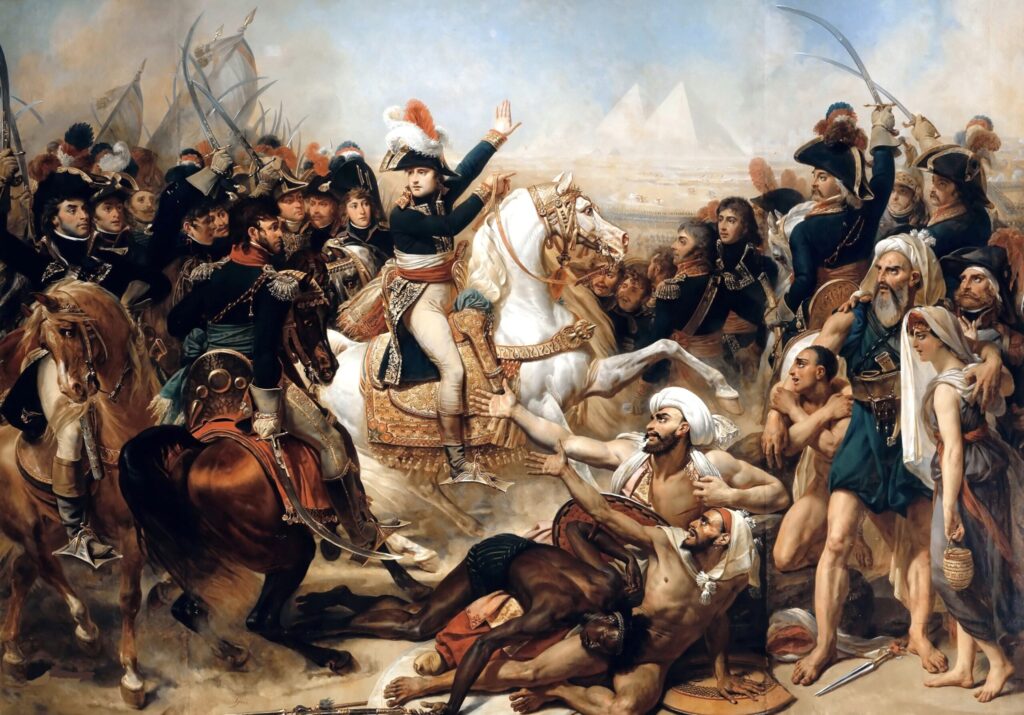
For many of us who got our first glimpse of world history in elementary school, the Egyptian pyramids were the symbol that we viewed as the start of it all. Decades have passed since then, but a fascination with that civilization has endured. Napoleon’s 1798 Battle of the Pyramids and defeat of the Malmuks in Egypt was captured in the famous painting by Antoine-Jean Gros. More importantly, Napoleon’s campaign was accompanied by a scientific expedition, marking the beginning of Egyptology.
Screenshot

Louve pyramid entrance by I.M. Pei. Photo: Stanley Collyer
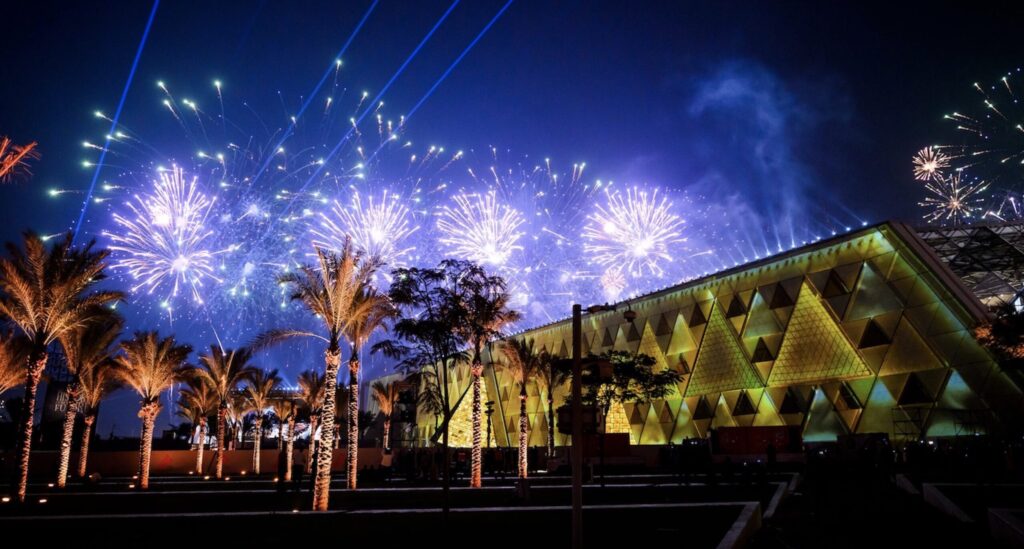
Over a century and a half later, another Frenchman, President François Mitterand, commissioned architect I.M. Pei to design a modern version of that icon as a new entrance to the Louvre. With a dedication ceremony on November 1st, marking the completion of the Grand Egyptian Museum project, thereby combining the resources of several other museums in Cairo, it would seemed to have brought the saga surrounding these monuments full circle.

Screenshot
Starting with the launching of a U.I.A. open design competition in 2002, won by the Irish firm Heneghen Peng, the museum project faced several delays along the way, the most notable being caused by the Covid pandemic. Now completely open to the public, it marked the second successful competition administered by the Union of International Architects (U.I.A.) under the auspices of UNESCO in Egypt.
The 1989 competition for the modern Alexandria Library, the Biblioteca Alexandrina, was won by an unknown young team of architects, collaborating between a small Norwegian firm, Snøhetta, and team in Los Angeles, some of whom subsequently joined the firm in Norway. That project was completed in 2002 to international acclaim. These were not the only international competitions where the U.I.A. played an important role. Some of the most high-profile being the Sydney Opera House (1957-1973), Centre Pompidou, Paris (1971-1977), and Tokyo Forum (1989-1996). It should be noted that these competitions were completely open to competitors from around the world.
The Grand Egyptian Museum Competition
The competition was launched on January 7, 2002 at a press conference by Minister of Culture, Farouk Hosny. It was described as a two-stage, open, international competition with a stated mission: to identify a design that would also fit well within the context of Egyptian culture. The museum was to have a total area of 424,000m2. No budget was mentioned.
The site for the museum is unique, as it is a neighbor to the Giza Pyramids, and at its maximum height also reveals panoramic views not only of the pyramids, but also of the city of Cairo’s skyline. Although in the desert, the site is anything but level, but extends from 30 meters above sea level at the main entrance from the main highway to 68 meters at its apex.
After the announcement of the competition, there were over 6,000 visitors to the website and 2, 226 registered for the competition. From those, 1,557 entries from 83 were received. These were scrutinized by a technical team that screened the designs, and of these 1,321 were cleared for adjudication as valid submissions. Here one must note that 55 days were then reserved for the technical committee to reexamine every entry, “to read every single word, examine every drawing or sketch, and decipher every thought or concept presented by all architects.”
The expert jury was composed of two Egyptologists, a museologist and six architects:
• Prof.Dr. Jong-Soung Kimm, President (Korea, UIA representative)
• Prof.Dr. Ana Maria Zahariade (Romania, Deputy UIA representative)
• Prof. Peter Cook (England)
• Prof.Dr. Salah Zaki Said (Egypt)
• Dr. Galal Abada (Egypt)
• Mrs. Gae Aulenti (Italy)
• Prof.Dr. Gballah Ali Gaballah (Egypt)
• Prof.Dr. Sergio Dondoni (Italy)
* Mrs. FranAoise Cachin (France)
Deputy Jury Members
• Prof.Dr. Fayza Haikal (Egypt)
• Prof.Dr. Arne Eggebrecht (Germany, First Stage only)
Compensation and Awards
The 20 competitors shortlisted for the second stage were all to received USD 10,000.
Prize money in the amount of USD 700,000 was set aside for winners according their ranking in the second stage:
• First Prize $250,000
• Second Prize $150,000
• Third Prize $100,000
High Honorable Mentions (3) $40,000 each
Honorable Mentions (4) $20,000 each
After the completion of the final adjudication process, the awards were as follows:
• 1st Place – Heneghan Peng Architects, Dublin, Ireland
• 2nd Place Coop Himmelb(l)au, Vienna, Austria
• 3rd Place Renato Rizzi, Venice, Italy
High Honorable Mentions
• Manuel Rocha Aires Mateus, Lisbon, Portugal
• Rubin Verdi, Italy
• Zimmermann Architekten, Bensheim, Germany
Honorable Mentions
Hector Vigliecca Gani, Luciene Quel, Sao Paolo, Brazil
Fernando Pardo Calvo, Madrid, Spain
Joana Henriques Ribeiro, Zürich, Switzerland

Screenshot
The final decision by the jury, especially in light of the diverse cultural backgrounds of its members, was certainly vindicated by the choice of Heneghen Peng as the winner. By combining the resources of numerous museums at one location, it will now take its place as one of the world’s major museums.

Screenshot

Screenshot
As for the administration of the competition itself, the extensive two-volume work produced at its conclusion by the sponsor will go down as one of the finest documentations of this process on record. Moreover, the U.I.A. again makes a strong argument for the practice of open design competitions and the quality of the products resulting from them.
Unless otherwise noted, photography: Iwan Baan